

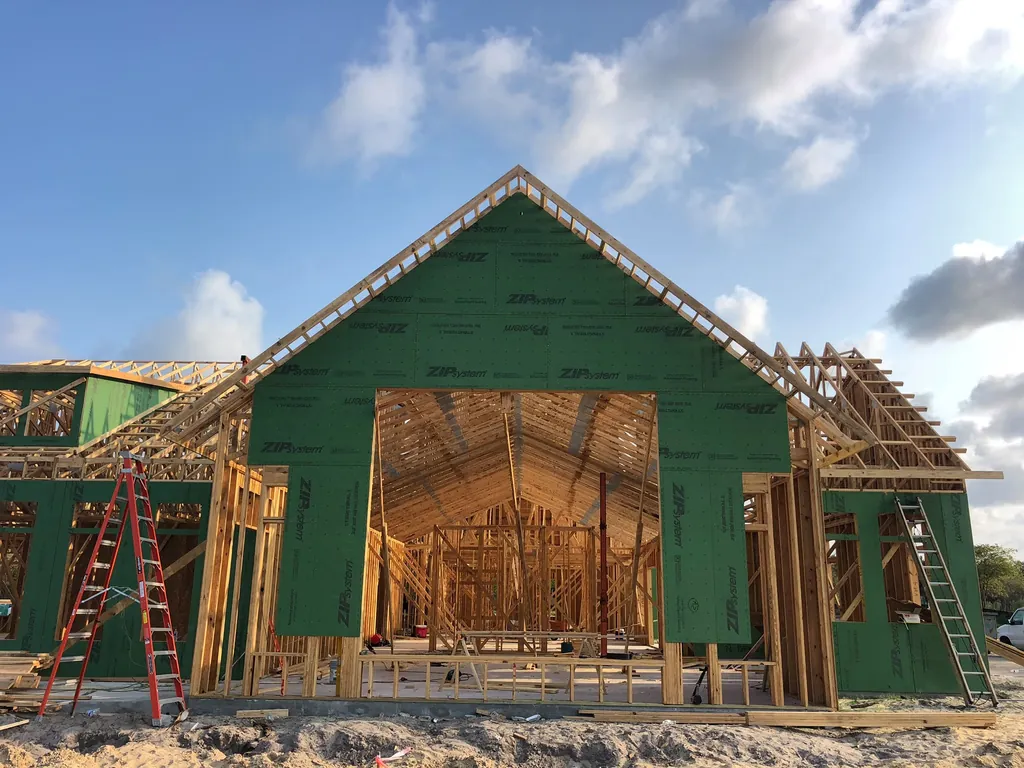
One of the most common questions we get from builders and homeowners is whether ZIP System is worth it over plain sheathing and house wrap. We install a lot of ZIP System across Northeast Florida, so here is how we explain the difference.
How a traditional wall is wrapped
On a traditional build, the framing crew nails up OSB or plywood sheathing. Later, sometimes days or weeks later, someone wraps the building in a house wrap, laps the seams, and tapes or staples it in place. The wrap is the water-resistive barrier. The sheathing is the structure.
That works when it is done well. The trouble is the gap in between. Bare sheathing sits out in the weather until the wrap crew shows up, and in Florida that usually means a few afternoon storms. Then the wrap itself has to be installed carefully around every window, door and penetration, by a crew that did not build the walls.
How ZIP System is different
ZIP System panels have the water-resistive barrier built into the face of the sheathing. Once the panels are nailed off, the seams get taped with ZIP System tape. That taped panel is the barrier. There is no separate wrap layer to install later.
Because our crew installs the panels and tape as part of the framing, the building is protected as soon as the frame is sheathed. That is a big reason we like it for Florida builds. Humidity and summer rain are hard on open framing, and the sooner the walls are closed in, the better.
What ZIP System does well
- Moisture protection early. The walls and roof are covered the day they are sheathed, without waiting on another trade.
- A continuous air barrier. Taped seams cut down on air leaking through the walls, which helps the house hold its cooling.
- One less subcontractor. The framing crew does the sheathing and the barrier, so there is one less crew to schedule and one less handoff.
- It is easy to inspect. You can see every seam and every piece of tape, so problems are easy to spot before siding goes on.
Where house wrap still makes sense
ZIP System panels usually cost more than standard sheathing plus wrap, so on a tight budget a well-installed wrap can be the right call. Some plans and some exterior finishes are also detailed around a traditional wrap. If the architect or engineer specified a certain system, we build what is on the plans.
The honest answer is that both systems can work. A sloppy ZIP System install will leak, and so will sloppy house wrap. The product matters less than whether the details are installed correctly.
The details that decide how it performs
With ZIP System, the parts that matter most are the ones that are easy to rush:
- Nailing the panels to the pattern the plans and the manufacturer call for.
- Taping every seam and pressing the tape down firmly with a roller so it bonds.
- Flashing window and door openings correctly before the windows go in.
- Sealing around penetrations and at the transitions between walls and roof.
We do those details the same way on a single custom home as on a three-story apartment building. On coastal homes the nailing also ties into the wind design, which we cover in our post on framing for Florida wind loads.
So which should you choose?
For most Florida builds where the budget allows it, we recommend ZIP System. You get the barrier on early, one crew responsible for the whole envelope, and a wall that is easy to check before it gets covered up. If budget is the main concern, a carefully installed house wrap is still a solid choice.
If you are pricing out a project, we can quote it both ways so you can compare. You can read more about how we handle it on our ZIP System installation page, or see how it fits into a full build on our new construction framing page.
Want a price for your project? Send your plans and we will reply, usually within 24 hours.